Model Railway
Wheel-Rail
Interface
& the importance of Back-to-Back dimensions
These help notes are for the benefit of railway
modellers.
They
were originally prepared for members of the Hornby Forum,
but equally apply to other makes.
|
Bachmann
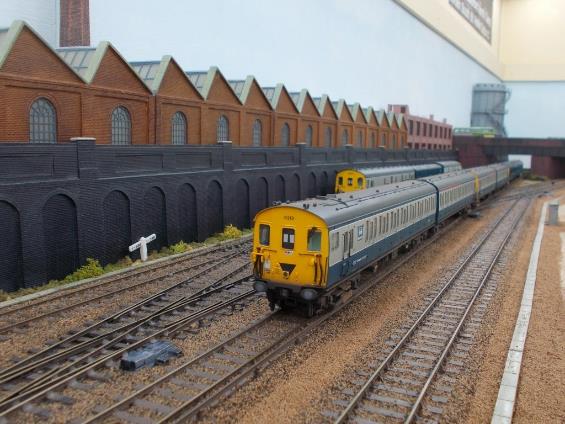
2 COM units on finescale track ©
Ewhurst Green |
Wheel-Rail Interface
On all railways the wheel-rail interface (in industry parlance) is the
crucial element in ensuring trains run. However, its importance can often be
overlooked or even misunderstood by some railway modellers – including
manufacturers. Standards used on railway models vary considerably (even within
a manufacturer’s own range) and this can lead to issues and poor running
especially on turnouts and crossings.
In terms of model rails incompatible wheel standards will cause
problems. For example, early Rovex models with coarse plastic wheels will not
run properly on (say) code 75 track. However, even when the wheel profile is
compatible with the chosen track problems can still arise through the
back-to-back dimensions of the wheels being incorrectly set. The back-to-back
dimension being the measurement between the inside faces of the wheel flanges.
Derailments
Many modellers will have a turnout on their layout upon which a number
of items of rolling stock regularly derail. In the end that turnout gets lifted
/replaced, the problem appears to go away and the conclusion that it was badly
laid else faulty is arrived at.
Except,
was it?
Obviously uneven track will lead to derailments but so will defective
wheelsets. I don’t mean wheels that have chunk missing out of them; just
defective in their profile is poor and quite often their back-to-back dimension
is too tight.
When passing through a turnout’s common crossing there can be a tendency
for wheels to try and take a diverging route either jumping as the wheelset
catches the crossing nose or simply derailing. Wheelsets with tight
back-to-back (i.e. less than 14.5mm) have considerable sideways play on the
track as the flanges are not sitting snugly within each running rail; this
excessive lateral play between the running rails can often lead to poor
running.
With this excessive lateral play the rail vehicle itself can also move
more than it should. So, it struggles to follow the track and at certain
locations the tolerances required to keep the wheelset on the track are
exceeded leading to a derailment. Often this may happen with (say) two or three
wagons which are then labelled as being ‘rogue’ or troublesome and so are
‘carded’. Relegated to the back of the layout they are now rarely used without
further investigation.
Model
train wheelsets
As a railway modeller my layout has seen more visitor-mileage than with
my own stock and this provides an interesting insight into what occurs with
models. The coarse wheel profiles of Lima and Jouef
cannot run; neither can the older Triang and Hornby wheels but much of the
rolling stock today can. Indeed, even some of Hornby’s current pizza-cutter
wheels give problems (for example the model JA /JB - class 73 in TOPS parlance)
so are replaced with Ultrascale wheels (they produce excellent conversion packs for many models).
Moulded plastic wheelsets are taboo for similar reasons. Furthermore,
plastic wheels also build up dirt.
I know the track is now spot on – some adjustment of check rails,
K-crossings on slips (etc) followed many hours of running my own stock fitted
with finescale wheelsets amply demonstrates this. But then (say) that pesky
leading axle on a visiting Bachmann class 40 occasionally derails on the common
crossing of a single slip. Up-turned on the modelling desk, it is found that
the back-to-back dimensions of that ‘pesky’ wheelset was less than a millimetre
too tight and once gently opened out to 14.5mm the locomotive runs faultlessly
thereafter.
Another regular contender is (say) the Hornby modified Merchant Navy
class where the tender wheelsets are frequently too tight. Recently the leading
axle on one locomotive (i.e. on the pony truck) was found to be wide to gauge
leading to infrequent derailments until it was adjusted.
Excess
lateral axle play
Many model locomotives also have excessive lateral play in their driving
axles and for a layout where 3’ is the minimum radii (a standard used by a
number of us) this also leads to unreliable running. Wheels are removed and
(for a 2mm axle) 8 BA brass washers are inserted to reduce the sideplay; the locomotive’s running is significantly
improved. To be precise 8BA is 0.0866 in or 2.2 mm.
Of course, there are many who rarely encounter these issues and may even
be bemused by them. However, next time you have a derailment just get a set of
callipers out and check the dimensions of the derailed vehicle’s wheelsets –
you might just be in for a surprise!
Split
Axles
When it comes to split axles these can present a problem if the
back-to-back dimensions need adjusting for you can’t! Essentially you are down to replacement
wheelsets which is rarely possible or retiring the locomotive. Fortunately,
split chassis locomotives have fallen out of favour and in some instances
manufacturers have re-released versions of a particular model with a new
chassis.
Unfortunately, with the increased use of lighting (particular with
Pullman cars) split axles are finding favour is some coaches. However, this
rarely presents a problem.
Loose Wheels
/Deep Flanges
Some
Hornby coaches appear to have a slightly deeper flange than (say) Bachmann equivalents
with these deeper flanges contacting the sleeper
chairs on curves formed of finescale track such as SMP or Exactoscale.
In addition, on certain batches of coaches one of the wheels is not a firm fit
on its axle and can be prone to unwanted variations in its back-to-back
dimension (leading to derailments).
Accordingly,
some modellers may choose to replace the wheelsets on Hornby coaches with 14mm
Romford wheels (or equal equivalent), even resetting their back-to-back
dimension set to 14.75mm. As a consequence, running of these coaches is much
improved and whilst the cost of the 14mm disc wheel has significantly increased
to £2.50 /axle in 2012 (around a decade ago Romford wheels were 84p) for many the
expense remains worthwhile.
Back-to-Back
gauges
The standard ‘00’ back-to-back gauge is 14.5mm; anything less can be
considered as ‘coarse scale’ as used in toy train sets and historical models. The
use of a smaller ‘coarse scale’ back-to-back can lead to inferior running and
is generally avoided by discerning modellers.
However, although many finescale modellers may use 14.75mm /14.85mm
gauges these are not normally recommended for proprietary rolling stock unless
you are sure their use is compatible with the wheel’s profile.
Besides using a Vernier gauge several manufacturers make back-to-back
gauges.
GW Models of
Lancing, West Sussex make an excellent adjustable back-to-back gauge primarily
intended for steam locomotives
(mail-order but not on-line)
DCCconcepts produce a number of gauges including both the standard 14.5mm, ‘fine
14.75 and ‘special fine’ 14.85mm gauges.
Both C&L and Markits produce standard 14.5mm
back to back gauges.
Checking
the Back-to-Backs
by
LC&DR
Modern
‘00’ wheels should normally be 14.5mm between inside faces and if narrower that
that will cause derailments, especially at turnouts (points). It is possible to
buy a special gauge to measure this, but it is perfectly possible to use a
cheap Vernier gauge instead. Wheels found to be out of adjustment can usually
be adjusted by gently sliding them on the axle. Locomotive driving wheels
should only be tackled by experienced modellers.
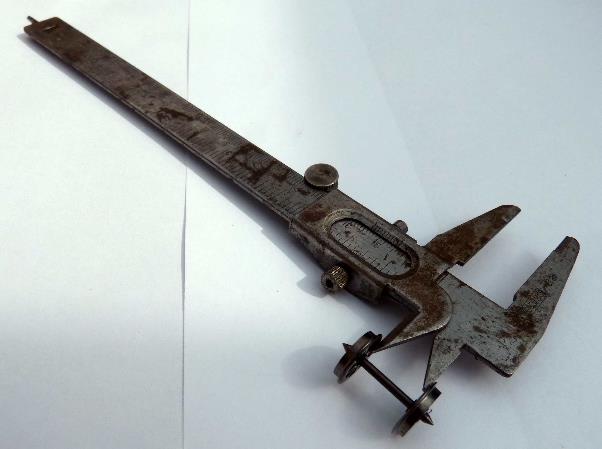
©Image LC&DR
Further reading
There
are defined wheel contours for RP25 and NMRA recommended rail practices.
The
Double O Gauge Association also publish their standards.
NMRA
also has a recommended practice
for wagon weight.
The
Scalefour Society publish on springing
for railway models (very specialist).
©BloodandCustard